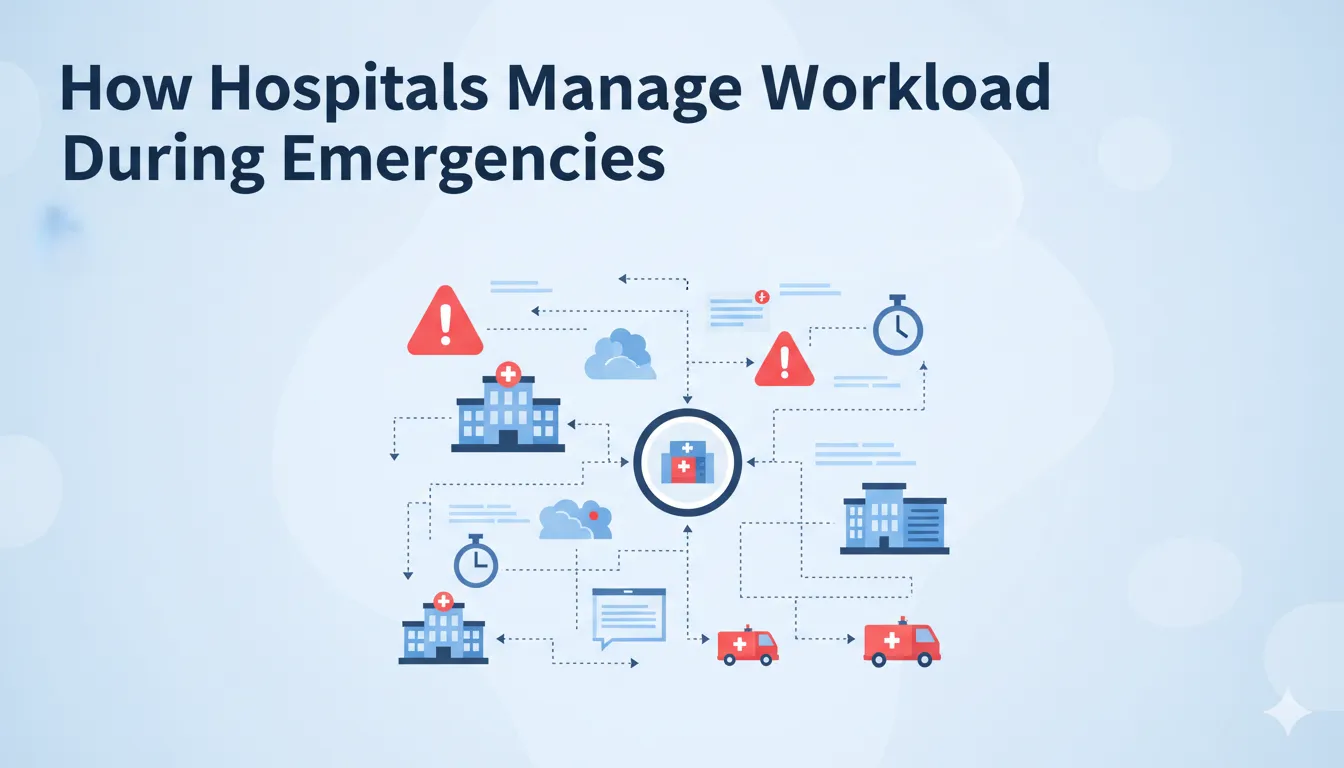
When a “Mass Casualty Incident” or a sudden surge hits, a hospital doesn’t just work harder; it transforms. Managing a workload during an emergency is the art of controlled expansion. You are taking a building with a fixed number of walls and a fixed number of people and trying to make it act like it’s twice its actual size.
It is a high-stakes, “all-hands” pivot where the standard rules of the day-to-day are suspended in favor of a survival-based hierarchy. Here is how the management team keeps the “dam from breaking” when the flood arrives.
1. The “Code Triage”: Activating the Command Center
The second an emergency is declared, the hospital’s normal management structure disappears and is replaced by the Hospital Incident Command System (HICS).
- The War Room: The senior leadership moves into a dedicated “Command Center.” They stop being “Managers” and start being “Section Chiefs” (Operations, Logistics, Planning, Finance).
- The Single Voice: During a surge, you can’t have ten people making decisions. Information flows upward to the Command Center, and one “Incident Commander” makes the final call. This eliminates the “bureaucratic lag” that kills people during a crisis.
2. The “Reverse Triage” (Creating the Space)
You can’t treat new emergency patients if your beds are full of people recovering from knee surgeries. Management initiates Reverse Triage to clear the “decks.”
- The Clearing: Every department head looks at their current patients and asks: “Who is stable enough to go home right now?” and “Who can be moved to a non-acute area like a cafeteria or a hallway?”
- The Surgical Freeze: All “elective” (non-emergency) surgeries are canceled instantly. The Operating Rooms and the Recovery Rooms (PACU) are cleared and held open for the incoming trauma cases. Within an hour, a well-managed hospital can “find” 20% more bed capacity just by clearing the backlog.
3. “Labor Pool” and Staff Redistribution
Managing the workload means moving the humans to where the “fire” is.
- The Call-In: The hospital activates its “Emergency Call Tree.” Off-duty staff are paged to report immediately.
- The Labor Pool: Staff who aren’t in the “line of fire”—like physical therapists, researchers, or even administrative staff—report to a “Labor Pool.” They are assigned “support” tasks like moving stretchers, fetching supplies, or acting as “runners” for the clinical teams.
- Skill-Mixing: You might have a pediatric nurse working in the adult ER. They might not know the adult protocols perfectly, but they can take vitals, start IVs, and act as an “extra set of hands” for the ER specialists.
4. Expansion into “Non-Traditional” Spaces
When the ER is full, management starts “opening” spaces that weren’t meant for patients.
- The Tent and the Hallway: You’ll see “Triage Tents” in the parking lot and “Hallway Beds” in the corridors.
- The Conversion: The physical therapy gym might be turned into a “Minor Care” zone. The lobby might become a “Family Information Center” to handle the influx of terrified relatives. Management’s challenge here is Logistics: you have to get oxygen tanks, monitors, and supplies to these “random” locations in minutes.
5. Supply Chain “Buffer” Management
During a surge, a hospital can burn through a week’s worth of supplies in six hours.
- The “Emergency Cache”: Most hospitals keep “Disaster Containers” locked in the basement. These are pre-packed crates of bandages, IV fluids, and basic trauma kits. Management authorizes the “breaking of the seals.”
- The Vendor Priority: The “Logistics Chief” in the Command Center is on the phone with suppliers, activating “Emergency Priority” status. They aren’t just ordering; they are demanding that the next truck on the highway be diverted to their loading dock.
6. Managing the “Secondary Crisis”: Information and Family
One of the most invisible workloads in an emergency is Information Management. * The Media Shield: If the management doesn’t control the narrative, the hospital will be overrun by reporters and “looky-loos.”
- The Social Burden: For every one patient, there are five family members looking for them. Management has to dedicate staff specifically to “Tracking and Identification” so they can tell families where their loved ones are. If you don’t manage the families, they will physically block the hallways and stop the clinical work from happening.
7. The “Recovery” Phase (The “After-Shock”)
The workload doesn’t end when the last patient is stabilized. There is a “Second Wave” of workload: The Reset.
- Decontamination and Restocking: The hospital is a mess. Rooms need deep cleaning, and the pharmacy needs to be completely rebuilt.
- The Emotional Debrief: Management has to look at the staff. They’ve just gone through a high-adrenaline, potentially traumatic event. If you don’t “debrief” and provide immediate mental health support, half your team will be calling in sick tomorrow, and the hospital will collapse during the “normal” workload of the next day.
The Bottom Line
Managing a hospital during an emergency is about Dynamic Prioritization. You stop trying to do everything perfectly and start trying to do the “most good for the most people.”
It is the ultimate test of a management team. It’s about having a plan that is rigid enough to provide order, but flexible enough to survive the reality of a chaotic world. When the “Code Triage” is finally over and the hospital returns to its normal rhythm, that success isn’t an accident—it’s the result of a system that was designed to bend without breaking.