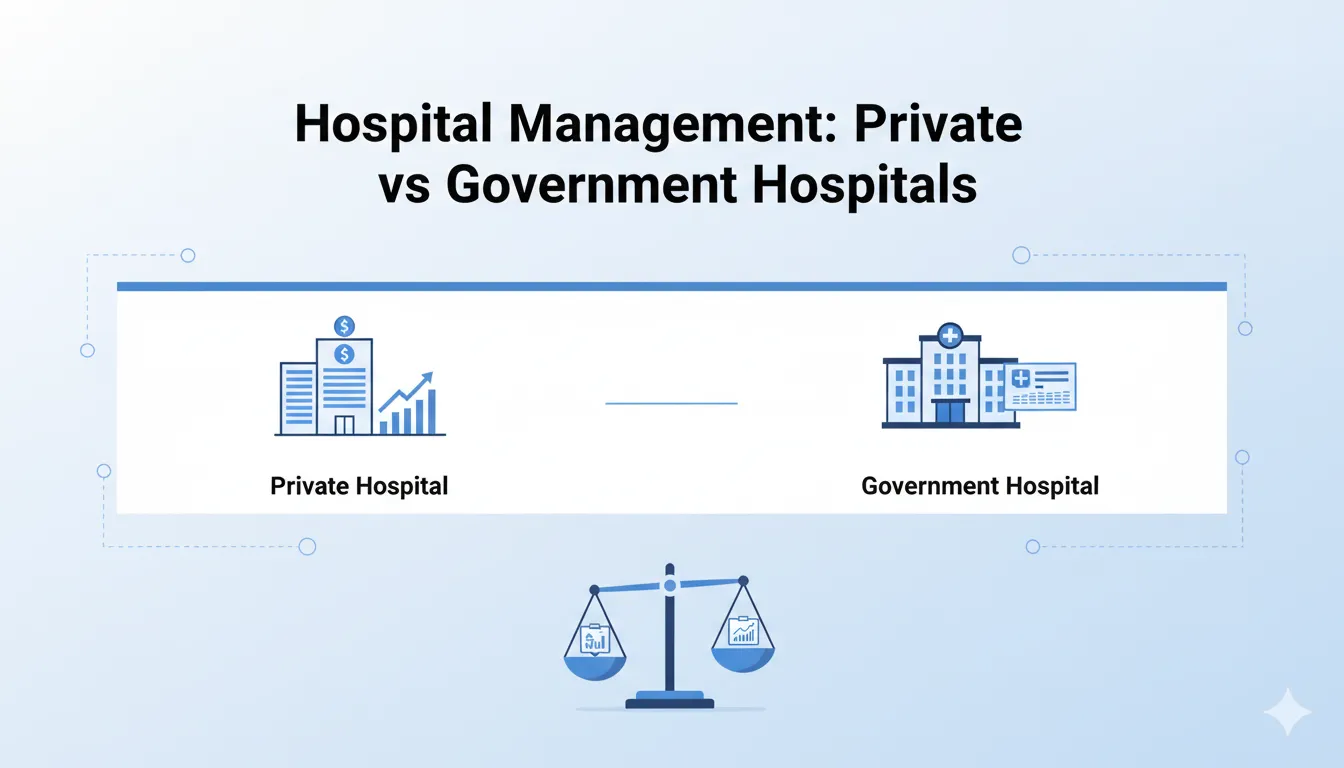
When you step into the world of hospital management, you quickly realize that while the medicine might be the same, the “soul” of the building changes completely depending on who owns the deed.
Managing a private hospital and managing a government facility are two entirely different types of warfare. In one, you’re a high-stakes corporate executive trying to keep a luxury liner from sinking into debt. In the other, you’re a battle-hardened general trying to keep an overcrowded fortress from being overrun.
Here is the raw, unfiltered reality of what it’s like to sit in the captain’s chair of both.
1. The Financial DNA: Profit vs. Survival
In a private hospital, the management team lives and dies by the “Customer Experience.” Let’s be honest: in this world, a patient is also a consumer. If the valet parking is slow, the Wi-Fi is spotty, or the cafeteria coffee is cold, the management hears about it—and it hurts the bottom line. You are constantly balancing the need for world-class, “Instagram-worthy” care with the cold reality of profit margins. Every MRI machine you buy has to pay for itself, or you’re going to have a very uncomfortable meeting with the Board.
In a government hospital, the financial challenge is the exact opposite. You aren’t trying to make a profit; you’re trying to make a miracle happen with a fixed pot of money that was probably decided by a politician who has never stepped foot in your ER. You aren’t worried about “customer reviews”—you’re worried about the oxygen tank shipment that’s three days late because of a bureaucratic paperwork error. Your “budget” isn’t a suggestion; it’s a cage. Management here is the art of “MacGyvering”—fixing a million-dollar problem with a hundred-dollar solution.
2. The Waiting Room: The “Squeeze” vs. The “Flood”
If you manage a private facility, your “waiting room” problem is about competition. If the wait time in your ER hits four hours, those patients are going to get in their cars and drive to the hospital across town. You manage the workflow to keep things moving fast, like a high-end restaurant trying to “flip tables.” You spend your nights worrying about “leakage”—patients leaving your system for someone else’s.
In the government sector, the waiting room isn’t a choice; it’s a sea of humanity. You don’t have to worry about patients leaving; you worry about where you’re going to put the ones who keep arriving. There is no “across town” for these people. Management in this environment is pure triage. You aren’t managing “flow” for comfort; you’re managing “flow” to prevent people from dying in the hallways. It’s a relentless, heavy pressure that never, ever lets up.
3. The Machinery of Power: Corporate Boards vs. Political Red Tape
Managing a private hospital means answering to a Board of Directors or a group of investors.1 They move fast. If you need a new billing system, you can get it approved in a month if the “ROI” (Return on Investment) makes sense. The challenge here is the “Quarterly Panic.” Everything is about the next three months. It’s a high-pressure, “what have you done for me lately” environment where your job is only as safe as the latest financial report.
In a government hospital, you don’t have a Board; you have a Bureaucracy. Every major decision—from hiring a new head of surgery to buying a new ambulance—has to go through a dozen different government offices. It’s like trying to run a sprint while waist-deep in molasses. You can’t just “fire” a bad employee, and you can’t just “buy” a new CT scanner. You have to navigate a labyrinth of civil service rules and political whims. The challenge here isn’t speed; it’s stamina. You have to be a master of “the long game” just to get the basics done.
4. The Workforce: High-End Specialists vs. The Front-Line Grunts
The management of staff in a private hospital is a prestige game. You are competing for the “Star Doctors”—the ones with the big reputations who bring in the wealthy patients.2 You have to keep them happy, cater to their egos, and give them the best toys to play with. If they leave, the revenue leaves with them. It’s a world of high salaries, high expectations, and very low patience.
In a government hospital, the staff are often there for the mission (or the job security). They are the “grunts” of the medical world. They are often overworked, underpaid, and dealing with the most difficult cases in the city. Management’s challenge here is preventing total emotional collapse. You are a cheerleader, a mediator, and sometimes a therapist for a staff that is perpetually exhausted. You don’t have the “shiny toys” to keep them there, so you have to build a culture of “us against the world.”
The Final Verdict: Two Different Nightmares
Neither one is “easier.”
- Private Management is a high-speed chase where you’re always one bad quarter away from a disaster. It’s sleek, it’s fast, but it’s cold.
- Government Management is a marathon through a swamp. It’s slow, it’s frustrating, but it’s where the most vital work often happens.
In the private world, you’re a Merchant of Health. In the government world, you’re a Steward of the Public. One worries about the “Patient Experience”; the other worries about the “Humanity of the System.”
At the end of the day, both management teams are doing the same thing: trying to keep the doors open so that when someone is having the worst day of their life, there’s a professional there to meet them. They just use very different tools to get it done.