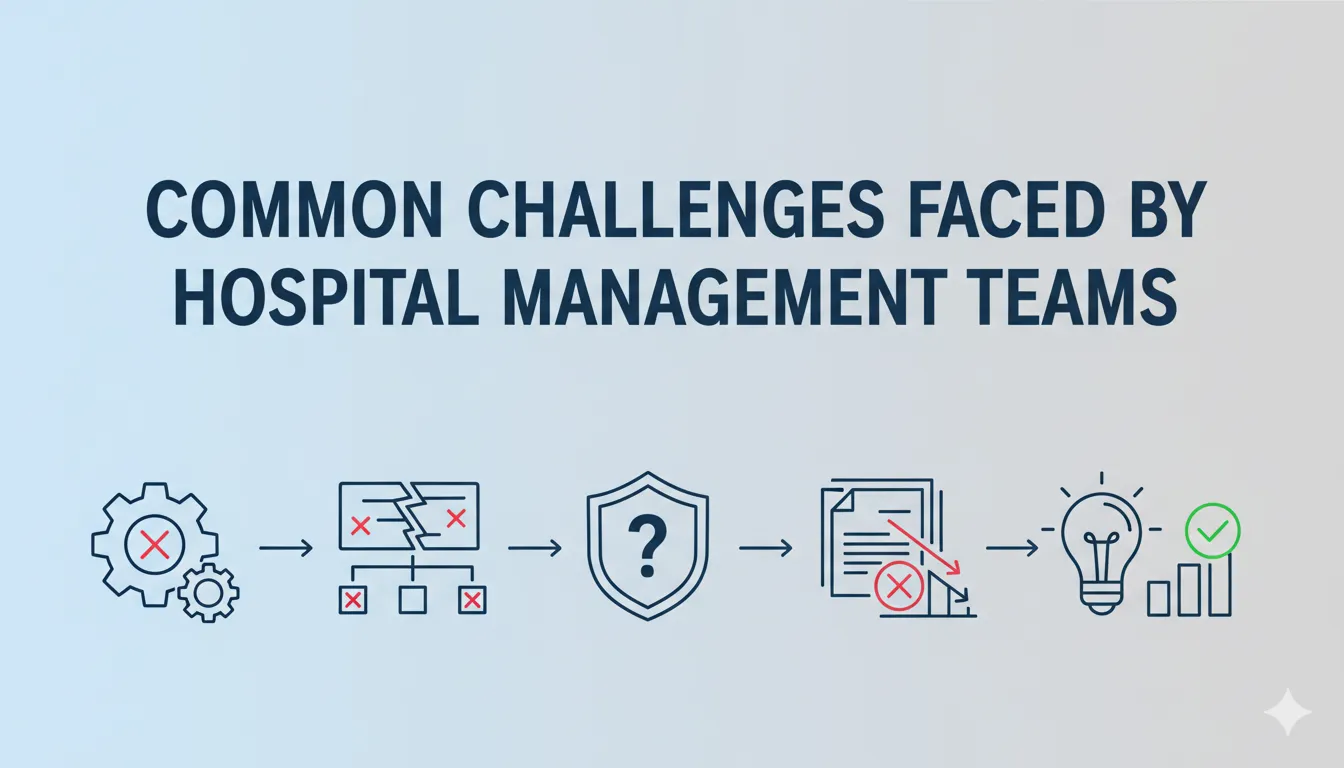
If you want to understand the challenges of hospital management, you have to stop thinking about “management” as a series of meetings and start thinking about it as trying to hold together a cracked dam with nothing but duct tape and sheer willpower.
Most people in leadership roles at other companies deal with spreadsheets and quarterly goals. In a hospital, the management team is dealing with a machine that is constantly trying to break, staff that are perpetually on the edge of burnout, and a financial reality that feels like a trap. It’s not just a job; it’s a relentless, 24/7 fight against friction.
Here is what keeps hospital management teams up at night when the rest of the world is sleeping.
1. The Staffing War: It’s Not Just About the Numbers
Every management team has a spreadsheet of “FTEs” (Full-Time Equivalents). But in a hospital, those numbers don’t tell the real story. The biggest challenge isn’t just finding a body to fill a shift; it’s finding someone who hasn’t already been pushed to their breaking point.
We are currently in a crisis of morale. You have nurses who have seen too much and worked too many double shifts. You have doctors who are buried under so much digital paperwork that they feel like data-entry clerks instead of healers. The management team has to walk a impossible line: they have to push the staff to meet “productivity” goals so the hospital doesn’t go broke, but if they push one inch too far, the best people quit.
When a veteran nurse walks out the door because they’re done with the stress, you don’t just lose an employee; you lose a decade of “institutional memory.” You lose the person who knows exactly which patient is about to crash before the monitors even beep. Management is constantly trying to plug leaks in a boat that is running out of sailors.
2. The Financial Trap: Mission vs. Margin
There is a saying in healthcare: “No mission without a margin.” It sounds cold, but it’s the hardest truth of the job. A hospital is a business that provides a service nobody wants to buy, to people who often can’t pay for it, using resources that cost a fortune.
The management team lives in the gap between the “Heart” and the “Wallet.” Every day, they are forced to make decisions that feel like a betrayal. “Do we renovate the aging labor and delivery wing, or do we buy the new cybersecurity software to stop hackers from locking our records?” You can’t do both.
Then there’s the insurance nightmare. Hospital management teams employ armies of people whose entire job is to fight with insurance companies to get paid for work that’s already been done. It’s a game of cat-and-mouse where the rules change every month. If the management team can’t get the “revenue cycle” right, the hospital dies. It doesn’t matter how good the doctors are if you can’t pay the electric bill.
3. The Great Cultural Divide
One of the most exhausting parts of the job is being the buffer between the “Scrubs” and the “Suits.”
On one side, you have the clinical staff who see every budget cut or new policy as a personal insult to patient care. On the other side, you have the Board of Directors or the corporate owners who are looking at the hospital as a line item on a balance sheet.
Management has to speak both languages. They have to go to a surgeon and explain why they can’t have the $3 million robotic arm this year, and then they have to go to the Board and explain why they can’t cut any more nursing staff without the whole place falling apart. You end up being the person everyone is mad at. You’re too “corporate” for the doctors and too “clinical” for the bean-counters. It is a lonely, thankless place to stand.
4. The Compliance Ghost
Healthcare is the most regulated industry on the planet, and the rules are constantly moving. Management teams live in fear of “The Surveyors”—the government inspectors who can show up at any moment and shut the place down.
It’s not just about big things; it’s about the tiny, invisible details. Is there a box of gloves sitting on a radiator? That’s a violation. Is a nurse’s password written on a sticky note? That’s a HIPAA breach. Is the temperature in the medicine fridge one degree too high? That’s a crisis.
The challenge isn’t just following the rules; it’s building a culture where a thousand people follow those rules every second of every day, even when they’re exhausted. Management has to be the “Safety Police,” which makes them the villains of the building, but if they stop being the villains, the hospital loses its license.
5. Future-Proofing a Moving Target
While management is dealing with the broken elevator and the nurse strike, they also have to be looking five years into a very foggy future.
Technology is moving faster than most hospital budgets can handle. Do you invest in AI-driven diagnostics now, or wait until it’s cheaper? Do you pivot to “telehealth” and risk losing your outpatient revenue?
Then there’s the changing community. If the city around the hospital is getting older, you need more geriatric beds. If a new specialized heart center opens up down the street, your best patients might leave. Management has to make multi-million dollar bets on the future, knowing that if they’re wrong, the hospital becomes a ghost town of expensive, obsolete equipment.
The Bottom Line: The Weight of the Chair
The biggest challenge of hospital management isn’t a single problem; it’s the cumulative weight of it all. It’s the realization that you are responsible for a building where there is no “off” switch and no “reset” button.
If a factory manager makes a mistake, they lose a day of production. If a hospital management team makes a mistake—in staffing, in budgeting, in safety—it eventually shows up as a “negative patient outcome.” That’s the polite way of saying someone got hurt.
That pressure is always there, humming in the background like the hospital’s own generators. It takes a specific kind of grit to stay in that chair, knowing that your job is to keep the “business” of healthcare from crushing the “spirit” of healthcare. It’s messy, it’s frustrating, and it’s arguably one of the hardest balancing acts in the modern world.