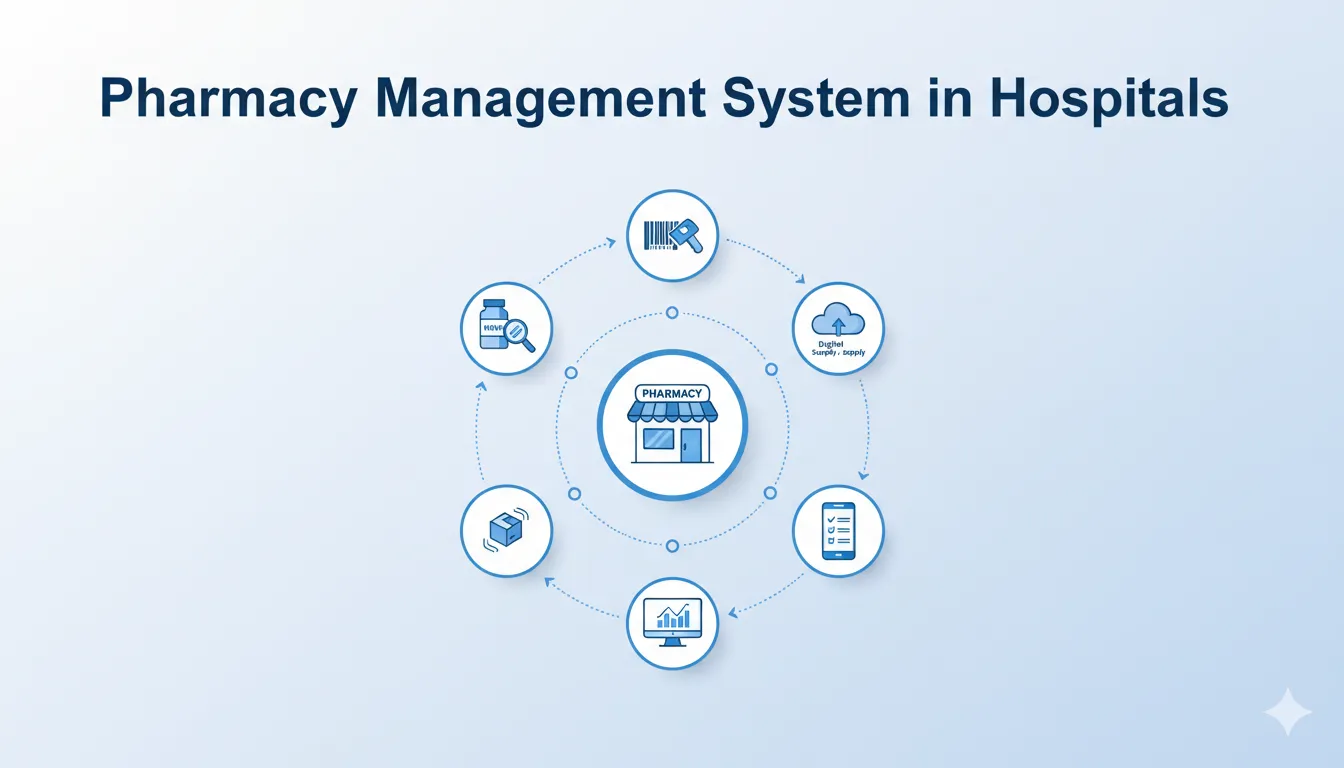
If the operating room is the “engine” of the hospital and the ER is the “front door,” then the pharmacy is the High-Security Vault. It is the most precisely controlled, high-stakes room in the entire building.
Most people think of a hospital pharmacy as a glorified version of the drugstore on the corner. That couldn’t be further from the truth. A Hospital Pharmacy Management System (PMS) isn’t just a database for pills; it is the Digital Guardrail that stands between a doctor’s quick decision and a patient’s fatal reaction. In a world where one misplaced decimal point can be a death sentence, the pharmacy system is the silent, unblinking eye that watches every single drop of medicine that moves through the walls.
Here is the “ground-level” reality of how a modern hospital pharmacy system actually keeps the chaos at bay.
1. The Digital Shield: Fighting the “Human Error” Factor
In the old days, a doctor would scribble a prescription on a piece of paper, a nurse would try to read the handwriting, and a pharmacist would guess what it said. It was a recipe for disaster.
Today, the Pharmacy Management System starts the second a doctor clicks “Order” on their computer. The system doesn’t just record the order; it interrogates it.
- “Wait, this patient is allergic to sulfa. Why are you ordering this?” * “Hold on, if you give this drug with the one they’re already taking, their blood pressure will tank.” * “This dose is 10 times the normal limit for a person this weight.”
This is what we call Clinical Decision Support. It’s the digital hand that grabs the doctor’s arm before they make a mistake. For the management team, this is the ultimate “Insurance Policy.” It’s about catching the error before it ever leaves the pharmacy basement. But it creates a new challenge: “Alert Fatigue.” Pharmacists spend their days clicking through hundreds of warning pop-ups. The trick for management is to make the system “smart” enough to scream only when there’s a real fire, not just a puff of smoke.
2. The “Pneumatic Pulse”: How Medicine Moves
If you walk through the hallways of a big hospital, you’ll hear a “whoosh” inside the walls every few minutes. That’s the Pneumatic Tube System. It’s the high-speed transit network that connects the pharmacy to every nursing station in the building.
When an “Emergency Order” (a “STAT” med) hits the system, the pharmacist preps it, bags it, and drops it into a plastic carrier. They punch in a code, and the tube sucks it up into the ceiling.
This isn’t just about speed; it’s about Tracking. The system knows exactly when that bag left the pharmacy and exactly which nurse swiped their badge to receive it at the other end. In a hospital, a “lost” bag of medicine isn’t just a late delivery—it’s a major security breach. If a high-dose narcotic goes missing in the tubes, the whole building goes into a lockdown of paperwork and finger-pointing. The management system has to be the “GPS” for every single pill.
3. The “Robot in the Wall”: Automated Dispensing Cabinets
The most visible part of the Pharmacy Management System isn’t in the pharmacy at all; it’s the Automated Dispensing Cabinet (often called a Pyxis or Omnicell) sitting on the patient floors.
Think of these as high-tech, high-security vending machines for drugs. A nurse can’t just walk up and open a drawer. They have to scan their fingerprint or swipe their ID. They have to select a specific patient. The drawer only opens for the exact medication that the doctor ordered and the pharmacist verified.
For the management team, these machines are a godsend for “Inventory Control.” The system knows in real-time when the supply of Tylenol is getting low or when a bottle of expensive heart medication is about to expire. It prevents “hoarding”—nurses hiding extra meds in their pockets “just in case”—and it makes sure the hospital actually gets paid for every dose given. If a pill comes out of that machine, it’s automatically added to the patient’s bill. No manual entry, no forgotten charges.
4. The “Vortex” of the Sterile Lab
While the machines handle the pills, the most high-stakes work happens in the IV Room or the Clean Room. This is the “Lab” where pharmacists mix chemotherapy, “TPN” (liquid food for the veins), and powerful antibiotics.
This is where the Pharmacy Management System becomes a Strict Choreographer. The pharmacist or tech works under a hood in a sterile suit. Every step is logged. The system tells them exactly how many milliliters of “Drug A” to add to “Bag B.” Often, they have to take a photo of the syringe at every step so the system can verify the volume.
The pressure in this room is suffocating. If a chemo dose is mixed incorrectly, you aren’t just giving the wrong medicine; you’re potentially giving a toxic dose.1 The management system acts as the “Double-Check.” It won’t let you print the final label until every digital “gate” has been cleared. It’s a slow, agonizing process, but it’s the only thing that allows the management team to sleep at night.
5. The Inventory Nightmare: The “Fridge That Can’t Fail”
A hospital pharmacy carries millions of dollars in inventory. Some single vials of “Orphan Drugs” (for rare diseases) can cost $50,000 each.
The Pharmacy Management System is the Financial Watchdog. It tracks expiration dates down to the hour. If a fridge door is left open and the temperature rises by three degrees, the system triggers an alarm on the manager’s phone. If that fridge fails, you aren’t just losing medicine; you’re losing the equivalent of a luxury car in wasted inventory.
Then there’s the Narcotics Vault. This is the “Federal Government” part of the job. Every milligram of morphine or fentanyl must be accounted for. The system tracks the “Chain of Custody” from the moment the drug arrives at the loading dock to the moment the nurse wastes the leftovers down the drain (with a witness). If the numbers don’t match—if there is even a 0.1ml discrepancy—it triggers an investigation that can involve the DEA. Management spends a huge chunk of their life just “reconciling” these numbers.
6. The “Invisible” Clinical Work
Beyond the pills, the Pharmacy Management System is a Clinical Research Tool. In 2026, these systems are used to monitor “Antibiotic Stewardship.” The system flags patients who have been on powerful antibiotics for too long, helping to prevent “Superbugs” from growing in the hospital. It flags patients whose kidney function is dropping, suggesting the pharmacist call the doctor to lower their dosages.
This is the “Proactive” side of management. Instead of just filling orders, the pharmacists are “hunting” for problems in the data. They are looking for ways to get the patient healthy enough to go home faster.
The Bottom Line: The “Last Line of Defense”
The Pharmacy Management System is the “Unsung Hero” of the hospital workflow. When it’s working perfectly, it feels like a boring, bureaucratic hurdle. Nurses complain about the fingerprint scanners, and doctors complain about the “Alert” pop-ups.
But for the hospital management team, that “boredom” is a miracle. It means the system caught the error. It means the inventory is stocked. It means the “Vault” is secure.
In the high-stakes, high-speed environment of a hospital, the Pharmacy Management System is the Last Line of Defense. It is the “Check and Balance” that ensures that in the rush to heal, we don’t accidentally harm. It is a messy, complicated, and incredibly expensive piece of technology, but without it, the modern hospital would be a far more dangerous place.